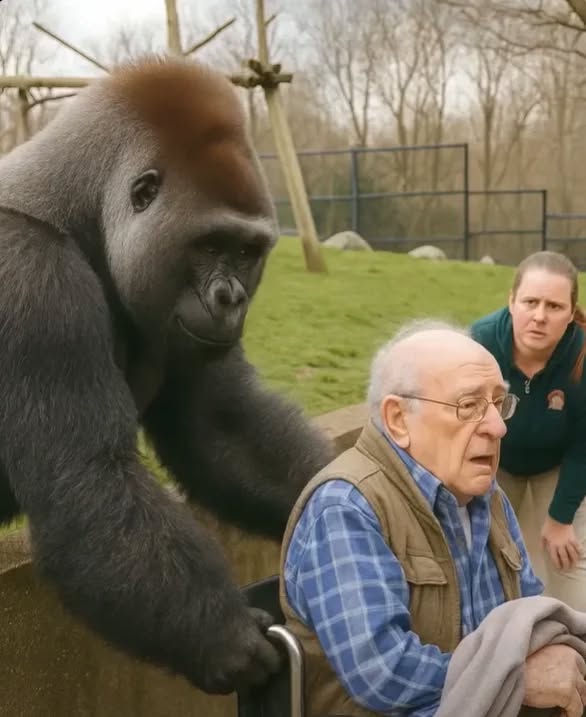
At the zoo, a gorilla suddenly attacked a man in a wheelchair, grabbed!
The warm afternoon sunlight drifted through the tall trees of the city’s oldest zoo, laying calm, golden shadows along the winding stone walkways. For longtime visitors and staff, it felt like any other Saturday—children laughing, popcorn rustling, and the deep, rhythmic sounds of the great apes echoing in the distance. Among the crowd sat a familiar figure: Arthur, an elderly retiree who had spent forty years as one of the zoo’s most respected primary keepers before a stroke confined him to a wheelchair and a quieter life.
Arthur had made peace with that quiet, as long as he could still spend his Saturdays near the gorilla enclosure that had once been his second home. He always positioned his wheelchair beside the glass, close to the animals he had cared for and studied for decades. To passing visitors, he looked like just another old man resting. To the gorillas, he was something else entirely—a known presence, a familiar scent, a face woven into their memory.
That afternoon, the air around the primate habitat felt heavier than usual, thick with damp earth and lush greenery. Arthur sat still, his worn hands resting on the arms of his chair, his gaze fixed on Juba, the dominant silverback, and Mala, a keen-eyed female known for her intelligence. Mala had been an infant when Arthur first joined the zoo, and years later, it was Arthur who had nursed her back to health after a serious illness.
Without warning, the calm shattered.
Mala rose suddenly and moved toward the boundary wall with startling purpose. There was no chest-beating, no bared teeth—none of the usual warning signs—but her focus was unmistakable. Reaching the reinforced barrier that separated the visitors from the habitat below, she did something that stunned everyone watching.
Leaning over the railing, Mala extended her powerful arm and wrapped her thick fingers around the rubber handles of Arthur’s wheelchair.
The crowd gasped in unison.
Before anyone could react, she pulled. The wheelchair lurched forward, its locked wheels screeching against the pavement. What had moments earlier been a peaceful afternoon instantly turned into chaos. Visitors screamed. Parents yanked children backward, certain they were witnessing something horrific.
“Help him! Call security!” someone shouted.
Two young men rushed forward, gripping the wheelchair frame and pulling with all their strength. “We’ve got you, sir!” one yelled. But their effort was nothing compared to the strength of a full-grown gorilla. Mala barely seemed to notice them. With one smooth motion, she dragged the chair—and the men clinging to it—closer to the ledge.
Zoo security arrived quickly. The lead ranger, Marcus—once trained by Arthur himself—skidded to a stop. He saw Mala’s grip, the raw power behind it, and then Arthur’s face. To his astonishment, Arthur wasn’t panicking.
“Everyone stop!” Arthur said firmly. “Let go of the chair. Stop yelling.”
“Arthur, she’s going to pull you in!” Marcus shouted, his hand hovering near his tranquilizer rifle.
“She’s not attacking,” Arthur replied calmly. “Look at her eyes. Really look.”
As the shouting faded, the truth became clear. Mala’s grip, though strong, was careful. She leaned forward and pressed her forehead gently against the glass, level with Arthur’s chest. She released a soft, rumbling vocalization—a sound of comfort and recognition. Arthur lifted a trembling hand and placed it against the glass in the same spot.
Mala loosened her hold slightly but did not let go. Instead, she began to gently rock the wheelchair back and forth, slow and rhythmic, like a mother soothing a child.
The idea of an “attack” fell apart.
The staff began to understand: Mala had sensed Arthur’s vulnerability. For decades, he had been the caretaker. Now, weakened and silent, he appeared to her as someone who needed protection. She wasn’t trying to harm him—she was trying to bring him back into the safety of her family.
Arthur spoke softly in a low, familiar tone he had practiced for years. Mala responded with a quiet huff, her dark eyes full of recognition. For several minutes, the two existed in their own private world, untouched by cameras or radio chatter.
Finally, Arthur turned to Marcus. “Bring her grapes and bamboo shoots,” he whispered. “We need to trade.”
The keepers approached slowly with Mala’s favorite treats. She glanced at the food, then back at Arthur. With one final gentle pat on the wheelchair frame, she released her grip and stepped back, never breaking eye contact. She retreated to the shade of a fig tree and watched him closely.
Later, reports were filed and media flooded in, but Arthur refused to let the zoo call it an attack. He knew better. What had happened was a rare moment of connection—proof of memory, empathy, and trust across species.
Mala had not forgotten the man who once saved her. She had simply believed it was her turn to protect him.
Arthur continued visiting every Saturday. A new safety barrier was installed, but a small plaque was added near his spot—not about danger, but about bonds. And each time Arthur arrived, Mala would come down from her perch, sit by the glass, and wait—her hand resting against it, making sure her old friend was never truly alone.