
Green Pink and Yellow in 1 Sentence!
Most people scroll past long joke compilations like they do junk mail: half amused, half irritated, hunting for that one line that actually lands. But this collection sticks because it follows a single, consistent engine: everyday authority being outwitted, absurd logic revealing nonsense, and human flaws earning the final laugh.
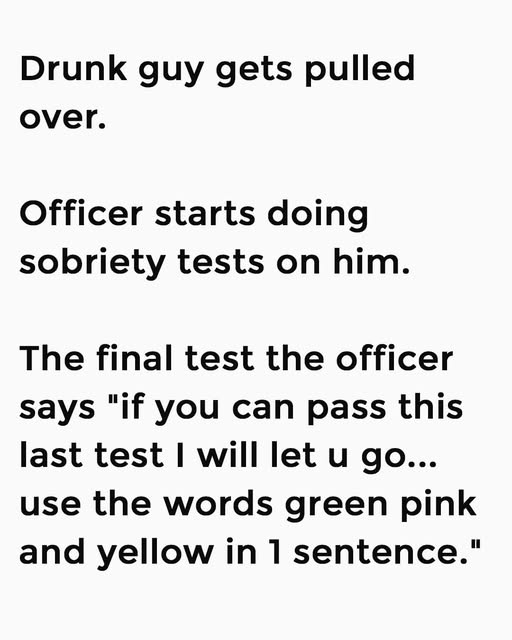
It starts with a classic “sobriety test” scenario. A drunk driver is pulled over, and the officer makes the final test a language challenge: use the words green, pink, and yellow in a sentence. The driver, completely disoriented, delivers a slurred punchline: “My phone went green and I pinked it up and said yellow.” It’s silly, clever, and exactly the kind of joke that spreads because the wordplay feels like a tiny miracle, even if it’s lowbrow.
Next, there’s a cleaner version of the same idea: a man tries to dodge every sobriety test with a medical excuse. Breathalyzer? Asthma. Blood test? Hemophilia. Urine sample? Diabetes. The officer finally says, fine, walk the line. The man admits the only truth he’s spoken all along: he can’t—he’s too drunk. The humor works because the lie builds momentum until it trips over itself.
Then the focus shifts to “the tough guy meets smarter authority.” A giant brags he can beat anyone and escape any trap. The officer treats his ego as an opportunity, handcuffs him, watches him fail, and arrests him as soon as the giant admits he can’t escape. The humor comes from simplicity—the giant’s arrogance seals his fate.
The tone softens with Grandma Bessie and Grandpa Morris. The officer brings Morris home, claiming he was lost. Bessie calls him out—he’s been going to the park for thirty years. Morris admits he wasn’t lost, just tired and wanting to avoid walking home. This joke lands because it’s relatable—honesty filtered through age and indifference.
Another classic gag: the truck full of ducks. The officer instructs an old man to deliver them to the zoo. Next day, the ducks are still there, now in sunglasses. The man explains: yesterday was the zoo, today they wanted the beach. Cartoon logic delivered straight-faced—it commits fully to absurdity.
Then there’s the sentimental cowboy. He orders three beers, one for each brother in different states. One day he only orders two; the bartender assumes a death, but the cowboy explains: no one died—one brother joined the Baptist church and quit drinking. Humor lands through misdirection and wholesome irony.
The genie story exaggerates “strings attached.” An old cowboy finds a genie in a briefcase—but she’s an Australian Taxation Office auditor. He wishes for an oasis, wealth, and women’s desire, and the genie turns him into a tampon. The moral: government perks always come with strings. Crude, but precise—escalation, bureaucracy, then punchline.
The money riddle tricks the reader into summing everything: 13 + 10 + 30 + 100 + 5. The question asks, “How much money did I have?” not “How much did I get?” The answer is 18: the original 13 plus “another 5.” The joke isn’t funny, it’s smug, which is why it circulates.
The compilation moves into domestic comedy. Bert and Edna trade petty confessions: sabotaged recliners, tampered remotes, secret bowling trophies. The humor is in realism: long marriages are full of quiet vendettas and playful espionage.
“Heaven is free” follows similar logic. A health-conscious wife’s lifetime of low-cholesterol meals leads to post-mortem abundance. The husband explodes: if not for her, they could’ve enjoyed paradise ten years earlier. Dark, but it nails twisted gratitude.
The pattern continues: misunderstandings as comedy weapons. Little Johnny fails math because the teacher’s equations always equal eight. A prisoner destroys a computer for a failed escape key. A boy names Jesus the most famous man because “business is business.” Each punchline stems from the collision of expectation and absurdity.
Even the “body-swap” joke follows this formula: a man envies his wife’s chores, swaps bodies with God’s help, drowns in domestic work, begs to switch back—only to find he’s pregnant. The humor is blunt, exhausting the reader as much as the character.
In essence, the collection is a parade of a single concept: people lie, boast, complain—and reality delivers a slap. Authority gets humiliated, arrogance collapses, ordinary life becomes absurd. Some jokes are clever, some groaners, some crude—but they endure because someone always thinks they’re in control… until they aren’t.