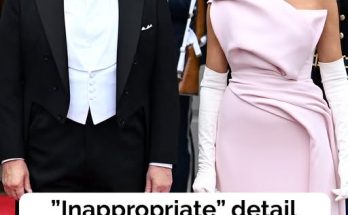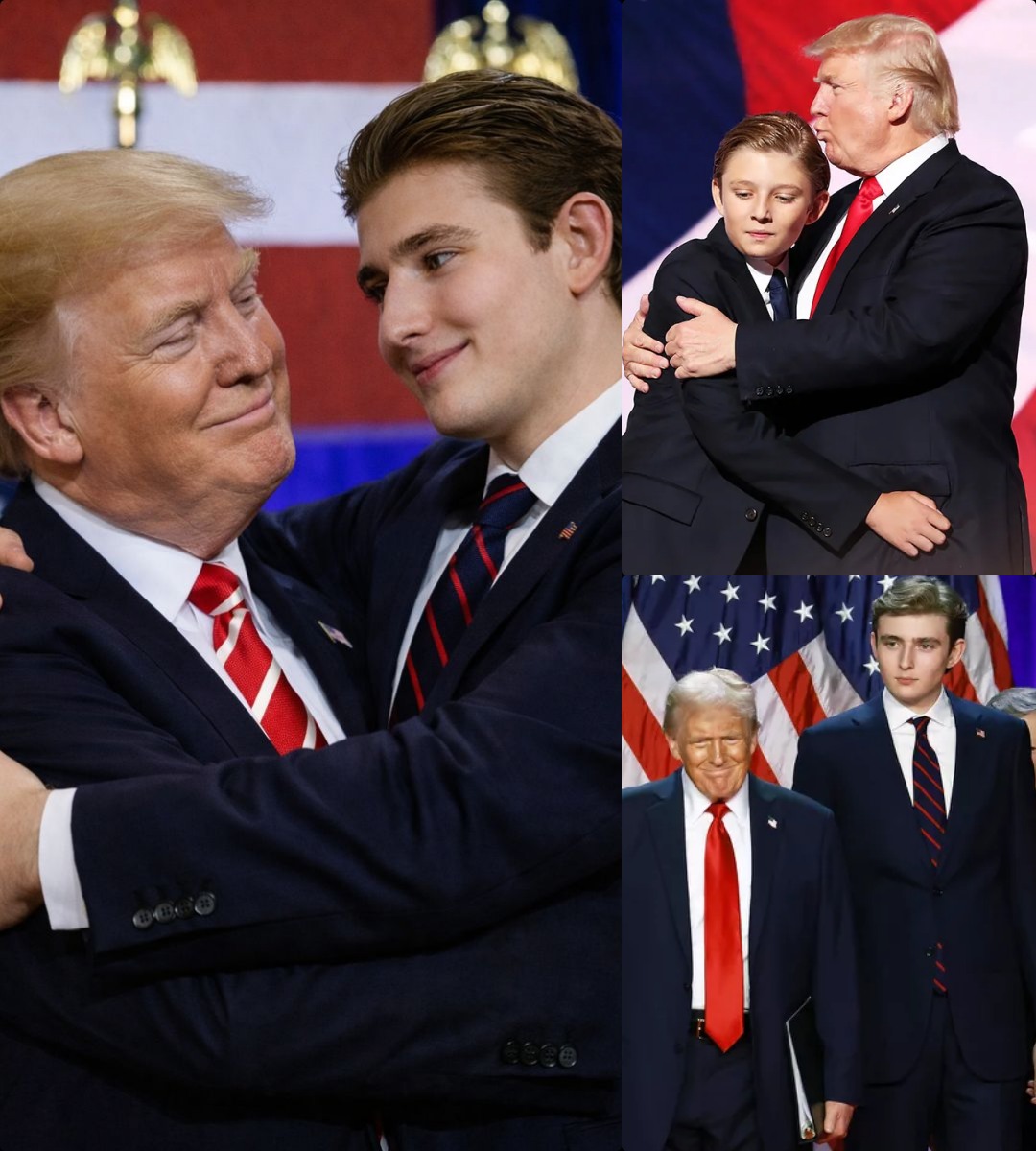
The evening had unfolded exactly as planned.
The setting was formal, carefully arranged, and emotionally charged in a familiar way. Guests were seated, conversations low and controlled, and the program followed its schedule with precision. When Donald Trump concluded his remarks—measured, deliberate, and delivered in the tone audiences had come to expect—the room responded with polite applause. Staff members began to shift slightly, anticipating the transition to the next segment.
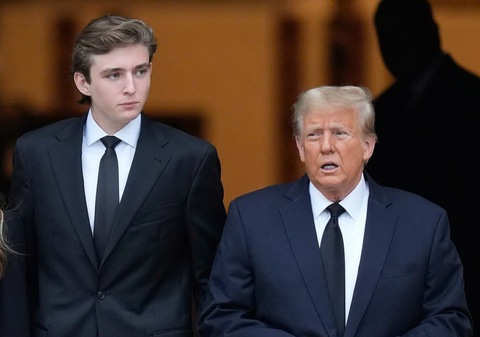
That was when Barron Trump stepped forward.
There was no announcement. No cue from the podium. No signal that the moment was about to change. Barron did not approach the stage or take the microphone. He moved only a few steps, closing the distance between himself and his father.
Then he spoke.
“I’m proud of you.”

The words were quiet, but unmistakable. They were not projected to the room, yet everyone heard them. Conversations stopped immediately. Chairs stilled. What struck the audience was not the volume or length of Barron’s words, but their clarity—and their intent.
After a brief pause, Barron continued.
“I’ve watched you carry responsibility that never really ends,” he said, looking directly at his father. “Not just in public, but when no one else is around. I know that part doesn’t get seen very often.”
The shift in the room was immediate.
Donald Trump, still standing from his speech, turned fully toward his son. Those closest to him noticed the change at once. The confident posture softened. The familiar composure gave way to something more personal.
Barron did not raise his voice. He did not embellish his words. He spoke plainly.
“I wanted to say this here,” he continued, “because no matter what people think or say, I’ve seen the work, the pressure, and the sacrifices up close. And I wanted you to know that I recognize them.”
The silence in the room deepened.
Nearby, Melania Trump lowered her gaze, visibly struggling to maintain composure. Those who noticed her expression later described it as unguarded—caught between pride and emotion. She did not interrupt. She did not move. She listened.
Barron paused again before adding his final sentence.
“And I’m grateful—not just as your son, but as someone who’s learned what it means to stand steady when the room is watching.”
That was all.
He did not linger. He did not wait for a response. He stepped back slightly, returning to his place beside his parents. The exchange had lasted less than a minute.
Yet it altered the entire evening.
Donald Trump did not speak immediately. For a moment, he simply looked at his son. When he did respond, it was not with a prepared remark or a return to the microphone. His voice was quieter than before.
“Thank you,” he said. “That means more than you know.”
Those closest to the family observed that his expression had changed—not dramatically, but unmistakably. It was the look of a father absorbing words he had not expected to hear in that setting.
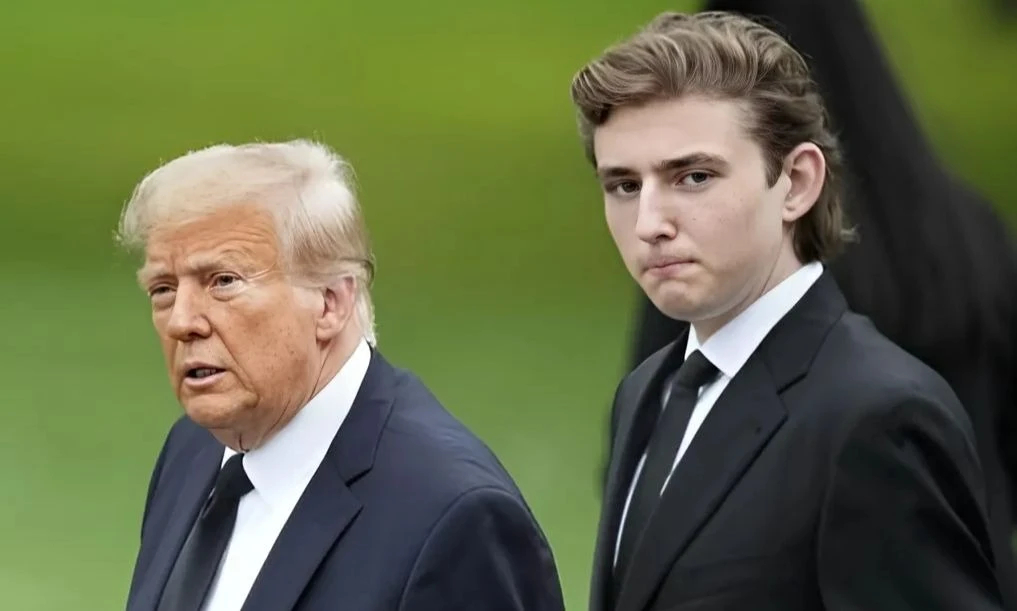
Melania Trump, standing nearby, wiped away tears. Later, she would privately admit that the emotion had taken her by surprise—that she hadn’t cried like that since her childhood. What moved her was not only what Barron said, but the timing, the restraint, and the certainty behind his words.
The audience remained silent for several seconds longer.
Then the applause came.
It did not erupt immediately. It built slowly, as if the room needed a moment to recalibrate. When it did, it was sustained and unprompted—not the applause of protocol, but of recognition. Many later described it as applause for the moment itself, rather than for any individual.
What lingered was not spectacle, but sincerity.
This was not a political exchange. There was no messaging, no agenda, no attempt to shape narrative. It was a son acknowledging his father in a space where personal moments are rarely allowed to exist without scrutiny.
Observers noted how unusual it was—not because of who was involved, but because of what was expressed. Public figures often speak about strength, leadership, and resilience. Rarely do they pause to acknowledge how those qualities are perceived by the people closest to them.
In that moment, Barron Trump did exactly that.
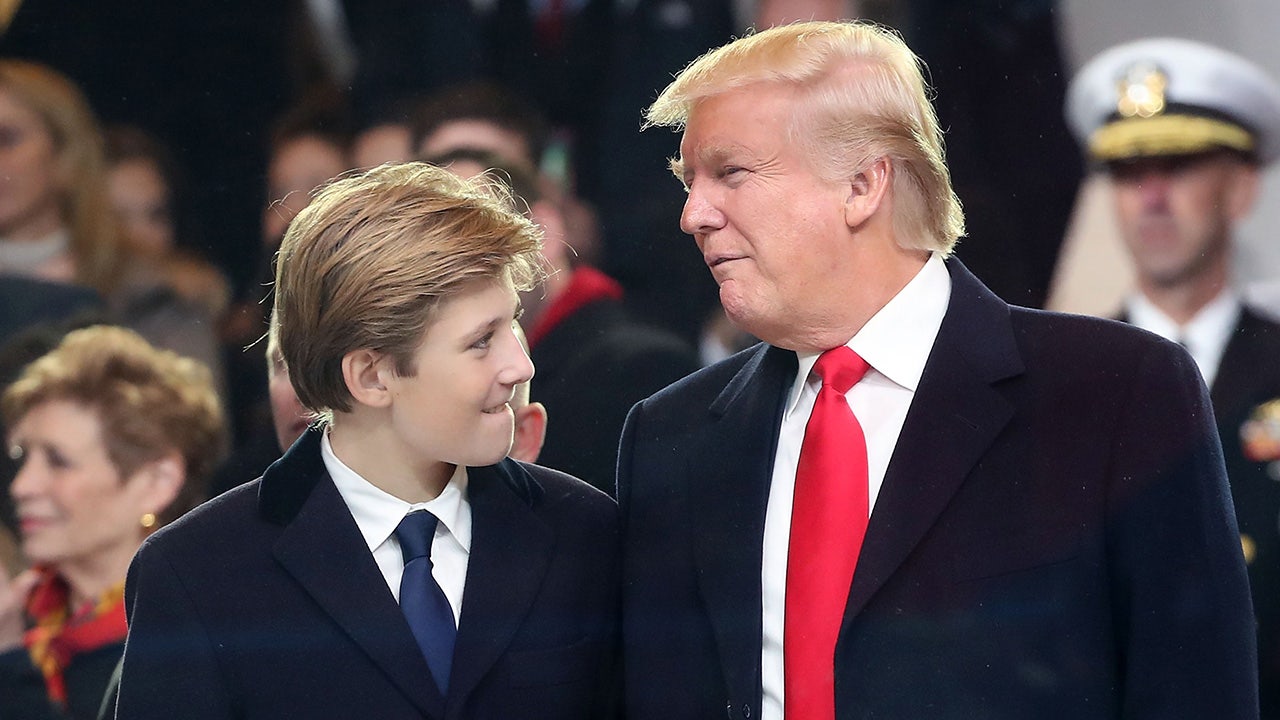
He did not speak as a representative, a symbol, or a public figure. He spoke as a son who had grown up watching responsibility unfold behind closed doors, and who chose to acknowledge it openly.
As the program resumed and the evening continued, the tone never quite returned to what it had been before. Conversations carried a different weight. The room felt quieter, more reflective.
Those who witnessed the exchange would later describe it as unexpected, deeply personal, and impossible to forget.
Because for one brief moment, a formal evening gave way to something unplanned—
a son’s pride, spoken plainly, and heard by everyone.
A YOUNG SOLDIER WALKED IN WEARING HIS LATE FATHER’S UNIFORM — AND WHAT HE SAID TO TRUMP AND MELANIA BROUGHT THE ROOM TO A STANDSTILL7!001

The young soldier stood quietly at the back of the room, his posture straight, his hands steady. What immediately caught attention was his uniform. It was clearly not new—slightly oversized, the fabric worn thin in places, the creases softened by time. It did not match the sharp, tailored attire surrounding him.
That was because it was not his.
As the formal event progressed, Donald Trump was midway through greeting attendees when the soldier slowly raised his hand in salute. Trump noticed at once and paused. Without consulting aides or cue cards, he asked the young man to step forward. Melania Trump rose beside him instinctively, her expression attentive and calm.
When the soldier reached them, he spoke plainly.
He explained that the uniform he wore had belonged to his father, a former serviceman who had passed away several years earlier. On the chest were insignia his father had earned through years of service—marks the son had deliberately left untouched. He wore the uniform that day not for recognition, but to honor his father’s memory and to deliver a message of gratitude long overdue.
Years earlier, during a difficult period near the end of his father’s life, the family had been facing a crisis. His father, struggling with serious health complications connected to his service, had been caught in bureaucratic delays related to medical access and benefits. According to the soldier, it was an intervention initiated through the Trump administration—supported personally by Melania Trump’s office—that helped cut through the delays.
The assistance was not publicized. There was no press release, no photo opportunity. But the result was tangible: expedited medical care, financial relief during treatment, and—most importantly, as the son emphasized—time.
“Those extra months mattered,” the soldier said quietly. “They gave us time as a family. They gave my father dignity.”
The room fell silent.
Trump listened without interrupting, his expression shifting from formal attentiveness to something more personal. When the soldier finished, the President reached into his jacket and removed a small, leather-bound item—a commemorative challenge coin bearing the presidential seal on one side and an inscription honoring military service on the other.
Trump placed the coin directly into the soldier’s hands.
“This belonged to your father as much as it belongs to you,” Trump said, according to those nearby. “He earned it.”
Melania then stepped forward and gently rested her hand on the soldier’s arm. Her gesture was brief, steady, and unmistakably maternal. She thanked him for carrying his father’s legacy forward and told him his presence that day honored not only his family, but every service member who sacrifices quietly.

At that moment, the soldier’s composure broke.
His shoulders tightened, his head lowered, and tears came—not from shock, but from release. Those watching understood this was not about the coin or the recognition. It was about being seen. About knowing his father’s service had not been forgotten.
Around the room, guests remained silent, many visibly moved. There was no applause at first, only stillness. When clapping finally began, it was slow and sustained, rising organically rather than on cue.
What struck observers most was the simplicity of the exchange. There were no cameras repositioned, no effort to frame the moment for effect. Trump and Melania did not linger. After offering a final nod to the soldier, they returned to their places, allowing the event to continue as scheduled.
Yet the atmosphere had changed.
Attendees later remarked that the encounter crystallized something often discussed but rarely witnessed so plainly: leadership expressed not through speeches, but through follow-through. Not through visibility, but through memory.
The soldier later explained that he had carried his father’s uniform for years, waiting for the right moment to wear it. He chose that day because he wanted to say thank you directly—not as a statement, but as a son.
“I didn’t come for recognition,” he said afterward. “I came because what they did mattered. And my father would have wanted them to know.”
By the time the event concluded, the story had quietly spread among those present. Not exaggerated. Not embellished. Simply shared.
In a world accustomed to spectacle, what lingered was restraint. A president who listened. A First Lady who comforted. A son who honored his father by telling the truth plainly.
The soldier left carrying the coin in one hand and his father’s uniform on his shoulders.
For many who witnessed it, the moment offered a clearer understanding of why gestures remembered years later often matter more than words spoken loudly in the present.
And why sometimes, the most powerful stories are the ones that were never meant to be told at all.