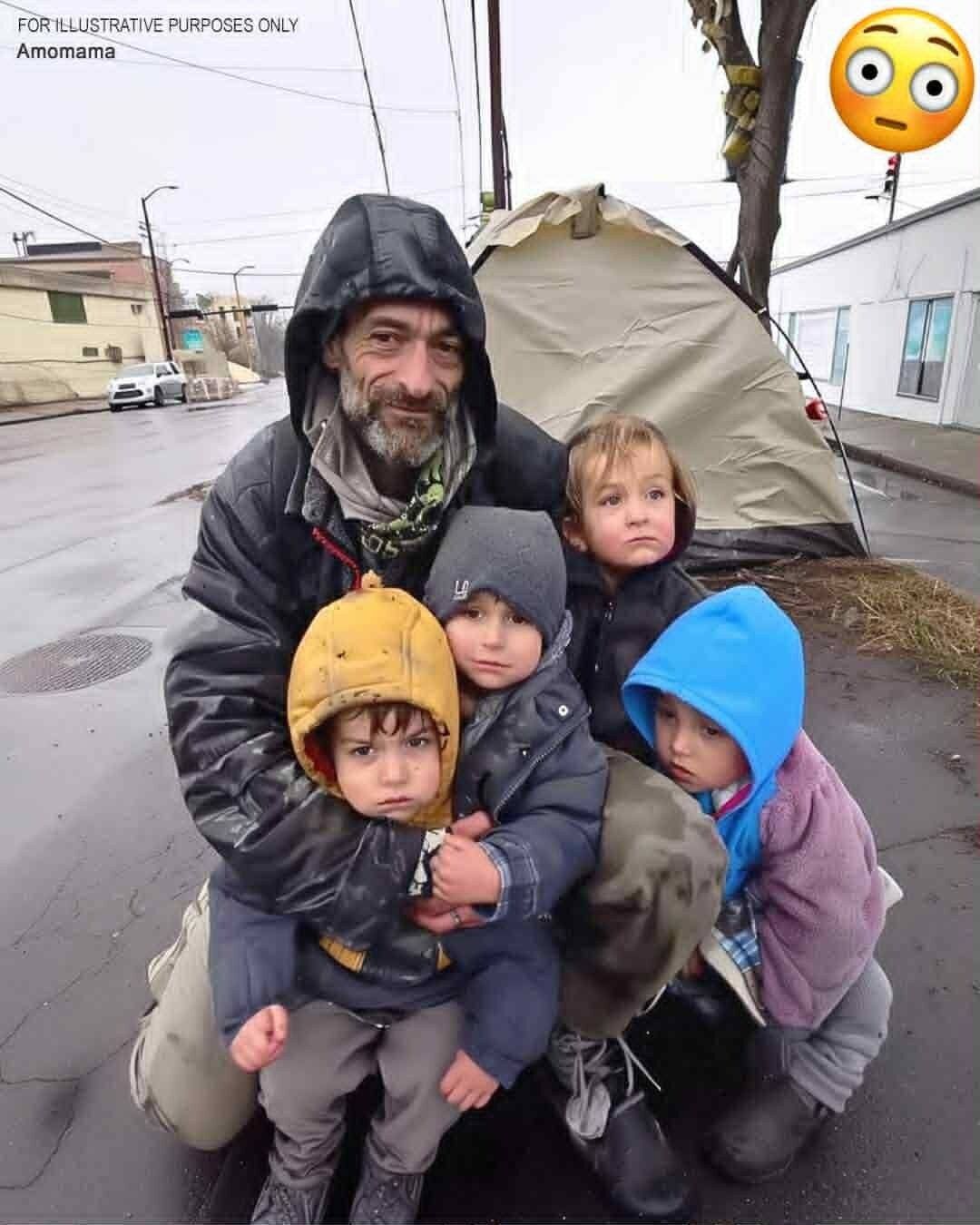
As Sean stood at the gas station, no one noticed him at first. That was nothing new. People rarely take a second glance at a man in worn boots and a faded jacket, with four children quietly waiting by a tent community. He blended into the background of everyday routines, the kind of presence society often learns to ignore.
But Sean’s life hadn’t always been this way.
Not too long ago, he was a manager at a logistics company in Oakland, earning a steady income, living in a modest apartment with his wife and their four children. Their life wasn’t lavish, but it was stable. Mornings were busy with school prep, evenings spent around the dinner table, and the comforting certainty that tomorrow would look just like today.
Then, his wife fell ill.
At first, it was just doctors’ appointments. Then came tests, and soon hospital stays stretched from days to weeks. The diagnosis was devastating, followed by treatments with price tags that drained their savings faster than Sean could replenish them. He sold the car. Then the furniture. Eventually, they had to give up their apartment.
Sean quit his job to be at the hospital full-time. He never regretted the decision. If his time was all he had to give her, he would offer every minute of it. But love doesn’t negotiate with reality.
His wife passed away quietly one night, leaving behind four children who still expected breakfast in the morning, and a father who no longer knew where they would sleep.
Grief doesn’t stop bills from piling up.
With no home or job to return to, Sean and his children found themselves in a tent community on the city’s outskirts. He picked up part-time work where he could while the kids were at school, but it was never enough. Every day was a decision: food or fuel, shoes or medicine, now or later.
But he made one rule for himself: His children would never see bitterness replace kindness.
That principle was put to the test one afternoon at a gas station.
Sean had taken the kids there to buy the cheapest meal he could afford: hot dogs and water. He counted his money twice before heading inside. Two dollars was all he had left after making sure the kids had enough for lunch.
As he approached the counter, he noticed an elderly man standing off to the side. The man looked unsettled, his hands trembling slightly as he tried to explain something to the cashier. Sean overheard enough to understand: the man needed water to take his medication but had left his wallet at home.
The cashier wasn’t sympathetic. Her voice rose as she told the man to leave if he couldn’t pay, pointing toward the door.
The man’s shoulders slumped as he turned to leave.
Sean hesitated. Two dollars. It was the difference between lunch for his children and nothing at all. He looked out the window at their tired faces waiting for him, their patience unspoken.
Then, he turned back to the old man.
He reached into his pocket and pulled out the crumpled bills.
“Sir,” he said quietly, holding them out. “It’s not much, but you can have this.”
The man stared at him, taken aback. “Thank you,” he said, his voice thick with emotion. “I just need water for my pills.”
Sean nodded. “That’s what it’s for.”
The man insisted on getting Sean’s phone number to repay him. Sean gave it without much thought. He didn’t expect anything to come of it—he just wanted to make sure the man was okay.
The next morning, Sean woke to the sound of engines outside the tent.
Two black SUVs were parked nearby. Men in clean jackets stepped out and approached him calmly. They handed him a sealed envelope and told him he needed to be at a specific address later that day.
Confusion turned to anxiety. Sean had grown accustomed to bad news, not good. Still, he went.
The address led him to a modern office building. Inside, he was escorted to a quiet conference room. At the table sat the man from the gas station.
The man’s posture had changed—he was confident now, composed.
He smiled. “Sean,” he said, standing to shake his hand. “My name is Matthew.”
Matthew explained that he owned a successful manufacturing company. The gas station encounter hadn’t been orchestrated, but it had been revealing. He’d watched dozens of people pass him that day—people with money, people in expensive cars—but none of them stopped.
Sean had.
“You gave me your last two dollars,” Matthew said, his tone steady. “Not because you had extra, but because you had character.”
Matthew went on to explain he was starting a new business venture and wanted a partner—not an investor with money, but someone with integrity. Someone who would put people before profit.
Sean was honest. He said he didn’t have money, a home, or stability to offer.
Matthew smiled. “I already have money,” he said. “What I don’t have enough of is heart.”
Sean agreed.
The weeks that followed felt surreal. He moved his children into an apartment. He returned to full-time work. He hired people from the tent community—people with skills but no opportunities. Matthew supported him, encouraged him.
The company grew steadily, not just in numbers but in trust. Sean’s children slept in beds again, ate meals without rationing, and shared laughter once more.
Sean never forgot where he came from.
He visited the tent community often, donated supplies, and hired when he could. He made sure his children understood that kindness wasn’t a currency to be spent for reward, but a principle to live by, no matter the outcome.
Looking back, Sean realized that his life hadn’t changed because of the wealth he encountered. It had changed because, even when he had nothing left, he chose to give.
Two dollars didn’t buy him a future. His character did.
And in a world that often measures worth by possessions, Sean showed that sometimes the smallest act, given at the hardest moment, carries the greatest weight.