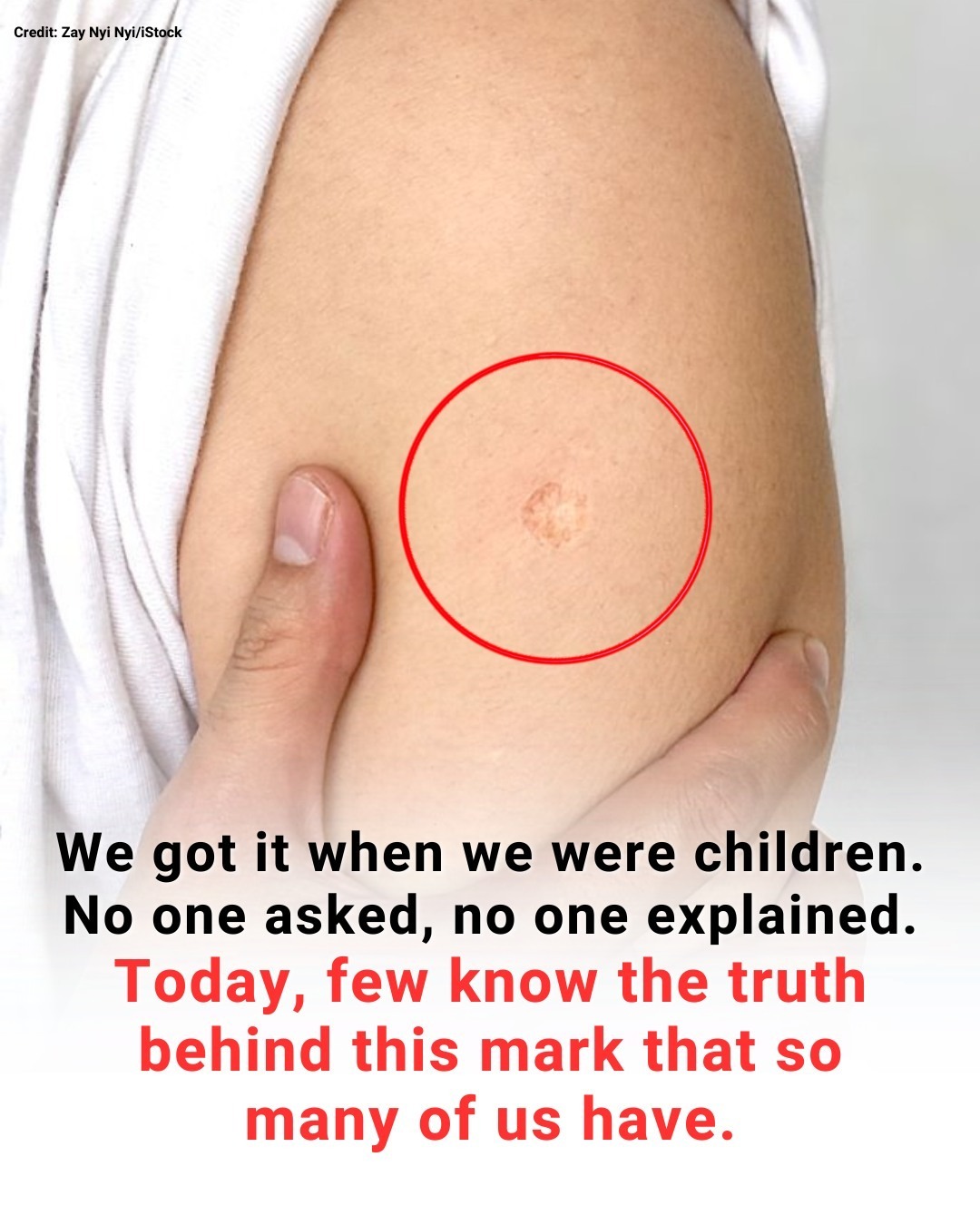

If you’ve ever caught a glimpse of a small, perfectly round scar on your upper arm—or someone else’s—you’re not alone. Millions of people around the world carry this subtle mark, often without knowing its origin.
For decades, it’s sparked myths, embarrassment, and wild guesses—from childhood burns to secret rituals. But the truth is far more profound: that little scar is a badge of global health history.
🔍 What Is That Round Scar?
It’s the vaccination scar from the smallpox vaccine—a life-saving shot that helped eradicate one of humanity’s deadliest diseases.
Administered primarily between the 1950s and early 1980s, the smallpox vaccine used a unique method:
A bifurcated needle dipped in live vaccinia virus (a cousin of smallpox)
The needle was pricked into the skin 15 times in a small circle
This caused a controlled infection, forming a blister → pustule → scab → permanent scar
The result? A coin-shaped, slightly indented scar—usually on the left upper arm (the non-dominant side for most).
🌍 Why Do Some People Have It—and Others Don’t?
Routine vaccination ended in most countries by the early 1980s after smallpox was declared eradicated in 1980 (thanks to a global WHO campaign).
If you were born before ~1985 in Asia, Africa, Latin America, or Eastern Europe, you likely received it as part of national immunization programs.
In the U.S. and Western Europe, routine smallpox vaccination stopped earlier (U.S. ended in 1972 for civilians), so many younger people don’t have it.
Military personnel and some healthcare workers may still carry the scar from later vaccinations.
✅ Fun fact: Smallpox is the only human disease ever eradicated—and that scar is a living reminder of one of medicine’s greatest triumphs.
❌ Common Misconceptions—Debunked: