The SHOCKING Truth Behind Queen Elizabeth’s Final Days

For over a year, Queen Elizabeth kept a secret from the world, one that would have changed everything. Behind the palace walls, she was fighting a battle no one was supposed to know about. The public had noticed she looked thinner, that she seemed tired, that she was missing events she’d never missed before. The palace blamed it on age, but it wasn’t age. It was something far more serious. She was dying.
By the summer of 2022, her private secretary understood she wasn’t going to recover. Yet, two days before her death, she was still standing, still smiling, still doing her job. The story of her final days reveals something the palace never wanted you to know: the photograph with the bruise on her hand, the family members who raced to reach her but arrived too late, and the daughter who was alone with her at the very end in the place she chose to die—500 miles from London, in the one place she had always been happiest.
In the summer of 2022, 70 years into her reign, Queen Elizabeth made a decision that would turn out to be one of her last. She chose to spend the season at Balmoral Castle, her Scottish estate, rather than remain closer to London and its medical facilities. This wasn’t unusual on the surface; Elizabeth had spent every summer at Balmoral for her entire reign, a tradition stretching back 70 years. But this time was different.
Her health had been declining significantly since the death of Prince Philip in April 2021. The loss of her husband of 73 years seemed to take something vital from her. She’d started using a walking stick for public engagements in October 2021, the first visible sign of her physical decline. That same month, she spent a night in King Edward VII’s Hospital in London, necessitating the cancellation of scheduled visits to Northern Ireland and the COP26 summit. A sprained back in November kept her from the National Service of Remembrance. Then, in February 2022, she contracted COVID-19. Her symptoms were described as mild and cold-like, but Elizabeth herself later commented that the disease “does leave one very tired and exhausted.” Those who saw her privately noticed she hadn’t fully recovered.
The energy that had carried her through seven decades of public service was finally beginning to fade. By the summer of 2022, the palace was regularly citing “mobility issues” to explain her absences from events. What they didn’t say publicly was that she was reportedly battling a form of bone marrow cancer called myeloma. According to biographer Gyles Brandreth, a close friend of the royal family, this would explain her tiredness, her weight loss, and those mobility problems that kept her from public view. The most common symptoms of myeloma are bone pain, particularly in the pelvis and lower back, and it’s a disease that often affects the elderly. There is currently no cure.
Former Prime Minister Boris Johnson later confirmed he had known for over a year that she had a form of bone cancer. Her private secretary had warned him that her doctors were concerned she could decline sharply at any moment. Yet, despite all of this, Elizabeth chose to be at Balmoral, 500 miles from London, far from the specialists and hospitals that could have been at her immediate disposal. She knew what she was doing, and she chose the place she loved most.
Balmoral wasn’t just a holiday home to Elizabeth. It was the place where she felt most like herself. The 50,000-acre estate in the Scottish Highlands had been in the royal family since 1852 when Prince Albert purchased it as a gift for Queen Victoria. Victoria fell deeply in love with the wild Scottish countryside, with its rolling heather-lined hills and crisp highland air. Elizabeth inherited not just the property but Victoria’s profound connection to the land itself.
Her granddaughter, Princess Eugenie, once said in a documentary that Balmoral was where the Queen was most happy. She described it as a place where you could breathe and run, where there were always walks, picnics, and dogs. So many dogs. The informality of life there stood in stark contrast to the rigid protocols of Elizabeth’s official existence. At Balmoral, Elizabeth drove her own Land Rover around the estate, often faster than her passengers were comfortable with. She hosted informal barbecues where she and Prince Philip would do the cooking themselves, serving stunned prime ministers who had expected silver service and found themselves being handed sausages by the monarch.
She went fishing for salmon in the River Dee. She stalked deer across the Highland moors, sometimes crawling on her stomach to get close to them. She took long walks through the pine forests and heather, going for miles without seeing another person. It was the one place where she could shed the weight of the crown and simply be herself. As she once said, “You can go out for miles and never see anybody. There are endless possibilities.”
Prince Philip had proposed to her there in 1946 during one of their long walks across the estate. They’d spent part of their honeymoon at Birkhall, a lodge on the Balmoral grounds, in the winter of 1947. Writing to her mother during that stay, the young Princess Elizabeth described it as “heaven up here.” Now, in the summer of 2022, she returned one final time. King Charles would later say in a speech to the Scottish Parliament that his mother especially treasured the time spent at Balmoral, and it was there, in the most beloved of places, where she chose to spend her final days.
She chose. That word matters. Even at 96, even with her health failing, Elizabeth was still making her own decisions about how she wanted to live and where she wanted to die. Just three months before her death, Elizabeth had made what would be her final major public appearance. In June 2022, the nation celebrated her Platinum Jubilee, marking 70 years on the throne. It was an unprecedented milestone; no British monarch had ever reigned so long. The celebration stretched across four days with parades, concerts, and events across the country. But Elizabeth’s participation was limited. Her health had deteriorated so significantly that she could only appear briefly. She watched the Trooping the Colour parade from the balcony of Buckingham Palace, but she had to withdraw from subsequent events to rest.
According to biographer Robert Jobson, despite doctors advising her to conserve her strength, Elizabeth was determined not to disappoint her people. She pushed through, and at the finale of the Jubilee celebrations, she made one last appearance on the famous Buckingham Palace balcony to acknowledge the crowds who had turned out to honor her reign. Charles reportedly persuaded her to appear for the sake of history. It took real courage given that she was allegedly in constant pain from her illness. It would be the last time the public saw her on that balcony, a spot indelibly associated with the British royal family.
By the time she traveled north to Balmoral for the summer, those who knew her well understood that her time was running short. Yet, she refused to simply retreat and wait for the end. She had one more duty to perform. On September 6th, 2022, just two days before her death, Queen Elizabeth performed her final constitutional duty. Normally, when a new prime minister takes office, they travel to Buckingham Palace to be formally appointed by the monarch. It’s a ritual that stretches back centuries, the symbolic moment when the power of government is conferred by the Crown.
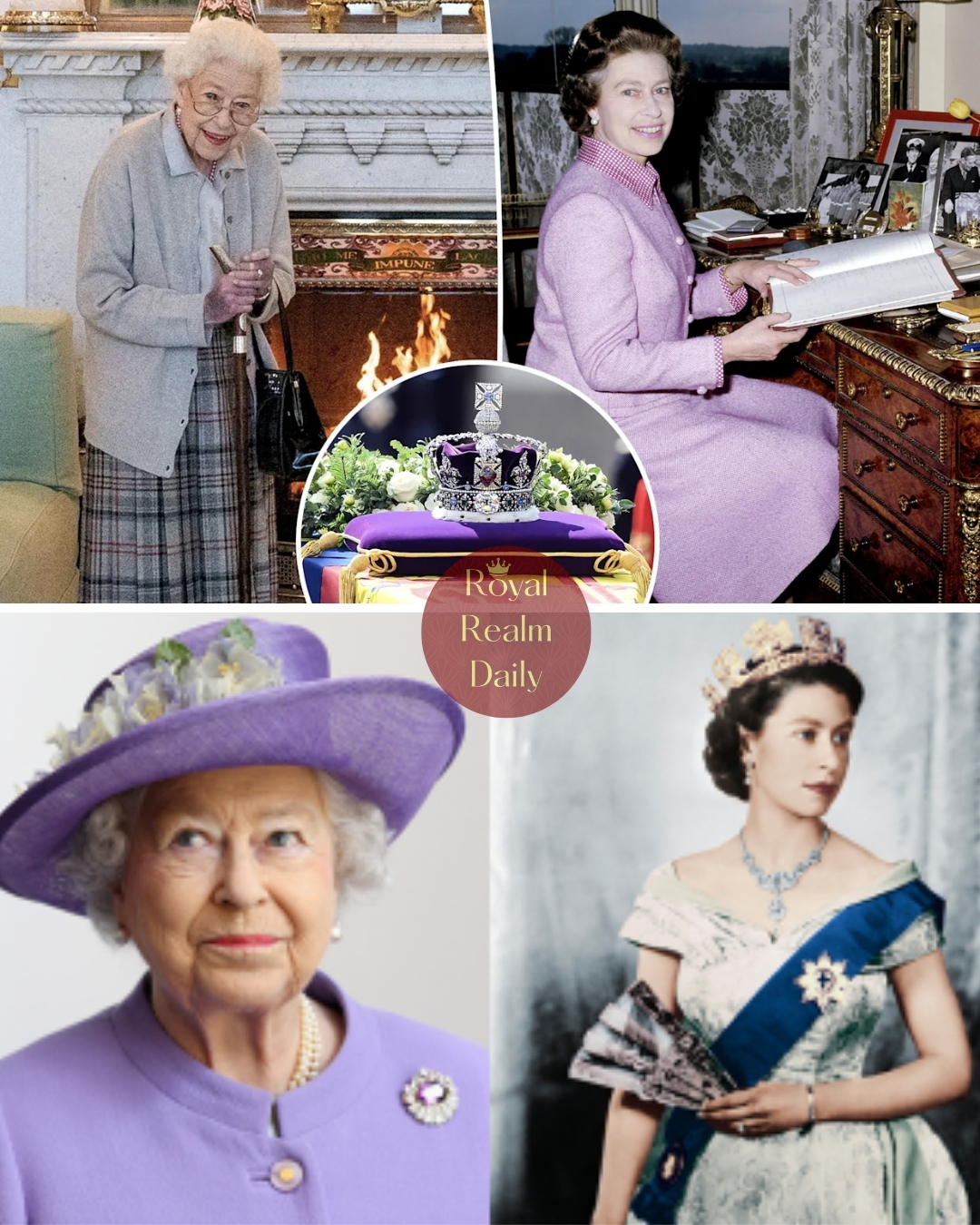
But Elizabeth was at Balmoral, and she was too frail to make the journey south. So, for the first time in her reign, the ceremony was moved to Scotland. Liz Truss flew north to Balmoral. Boris Johnson came separately to formally resign his position. And Elizabeth, despite everything her body was going through, stood to receive them both. The photographs from that day show a woman who was clearly elderly, clearly frail. She had lost significant weight. There was a dark bruise visible on the back of her right hand, which some later speculated was from an IV cannula, the kind used to deliver medication or fluids. Her eyes had difficulty focusing, but she was standing. She was smiling. There was still, observers noted, that familiar, mischievous twinkle in her eye. She was doing her job, 70 years on the throne, and she was still showing up.
What the public didn’t know was that her private secretary, Edward Young, quietly informed Liz Truss after the meeting that the Queen might not live much longer. He told Boris Johnson the same thing before his final audience: that she had “gone down quite a bit over the summer.” Johnson would later write that even then he believed there was still time. He was wrong.
The next day, September 7th, Elizabeth was scheduled to attend a virtual Privy Council meeting to swear in new ministers in Truss’s government. At 6:00 p.m., just as the meeting was supposed to begin, word came that it was cancelled. The Queen had been advised by her doctors to rest. It was the first real public sign that something was seriously wrong. The meeting had been cancelled at the very moment it was meant to begin. Those who understood royal protocol knew this was highly unusual.
By the following morning, the situation had become critical. The morning of September 8th, 2022, began with alarm bells ringing through the royal family. By 7:00 a.m., the Queen’s condition had deteriorated sharply. Her personal helicopter was dispatched to bring Prince Charles from Dumfries House, about 90 miles away. He arrived at Balmoral shortly before 10:30 a.m., rushing to his mother’s bedside. Princess Anne was already there; she had been staying with her mother at the estate and had been at her side throughout the crisis. Camilla, then Duchess of Cornwall, was driven over from nearby Birkhall, the residence she and Charles used on the Balmoral estate.
At 12:32 p.m., Buckingham Palace released an unusual statement. The carefully chosen words said the Queen’s doctors were “concerned for Her Majesty’s health” and had recommended she remain under medical supervision. The Queen, they said, “remained comfortable at Balmoral.” For anyone who understood the careful language of royal communications, this was deeply significant. The palace almost never commented on the Queen’s health in this way. The word “concerned” from royal doctors was not used lightly. The statement sent shockwaves through the country.
Twenty-eight minutes later, another announcement: Prince William, Prince Andrew, Prince Edward, and his wife Sophie were all on their way to Scotland. A plane carrying them left RAF Northolt and landed at Aberdeen Airport just before 4:00 p.m. The journey from the airport to Balmoral took about an hour. They arrived at the estate shortly after 5:00 p.m. Prince Harry, who was in the UK for a charity event, was also making his way north. He had been informed of the situation by his father and had cancelled his planned appearance at the WellChild Awards. He traveled separately from the other family members, but time was running out faster than anyone had anticipated.
Queen Elizabeth II died at 3:10 p.m. on September 8th, 2022. She was 96 years old. Only two of her children were confirmed to be with her at the moment of her death. Charles, her eldest son and heir, had been at her bedside that morning, spending precious final hours with his mother. But according to reports, he and Camilla had stepped out briefly in the early afternoon, leaving Princess Anne alone with her mother. It was Anne, the daughter who had perhaps always been closest to Elizabeth in temperament, who was by her side when she took her final breath.
Charles learned of his mother’s death by phone. He was on his way back when it happened. The news came as he was walking through the Balmoral grounds. William, Andrew, Edward, and Sophie arrived at the castle about two hours after she had already passed. They had raced against time and lost. Harry arrived later that evening after the public announcement had already been made. He had been traveling alone and had left later than the others.
The death was publicly announced at 6:30 p.m., more than three hours after it occurred. The delay allowed time for family members to be personally notified, for government officials to be informed, and for the formal protocols to be set in motion. The BBC interrupted its regular programming. News readers in black suits appeared on screen. Crowds began gathering outside Buckingham Palace in London, where a rainbow had appeared in the sky earlier that afternoon. Flags across the country were lowered to half-staff. Her death certificate, released weeks later, listed the cause simply as “old age.” No mention was made of cancer or any other specific condition. The palace declined to comment on claims about her health that emerged in subsequent biographies.
Elizabeth had been preparing for this moment for years. The plans for handling a monarch’s death had long been in place under the code name “Operation London Bridge.” But because she died in Scotland rather than England, a different protocol came into effect known as “Operation Unicorn.” She was the first monarch to die in Scotland since James V in 1542, nearly 500 years earlier. Even in death, she had done things her own way.
What becomes clear when you look at Queen Elizabeth’s final days is that she remained exactly who she had always been right until the end. She chose where she wanted to be. She kept working until her body simply wouldn’t allow it anymore. She found comfort in the place she loved most, surrounded by the Scottish landscape that had brought her peace since childhood. And she faced what was coming with the same quiet dignity she had shown throughout her 70-year reign.
There was no dramatic decline in a hospital bed. No weeks of public vigil. Just a 96-year-old woman who had served her country for seven decades, spending her final summer in the hills she adored and stepping up to perform her duty one last time, even when it took everything she had left. Elizabeth II lived a life defined by duty and service. But her final days revealed something more personal. They showed a woman who knew herself completely, who understood what mattered most to her, and who was determined to meet the end on her own terms, in her own place, surrounded by the land and the people she loved.