Posted March 25, 2026
Washington, D.C. — It was an evening designed for visibility, precision, and control.
Inside a grand ballroom just steps away from the political heart of the United States, hundreds of guests gathered for what had been scheduled as a formal address. Donors, officials, media representatives, and invited attendees filled the room, their attention fixed on the stage where former President Donald Trump stood behind a polished podium.
The lighting was warm but deliberate. Cameras were positioned strategically. Every detail had been planned.
Trump began his speech in a manner familiar to those who had followed him for years — confident, measured, and direct. He spoke about national issues, leadership, and resilience, drawing applause at expected moments. The audience responded with attentiveness, some nodding, others recording clips on their phones.
Nothing about the evening suggested anything unusual.
Until, suddenly, it changed.
Midway through a sentence — without warning — Trump stopped.
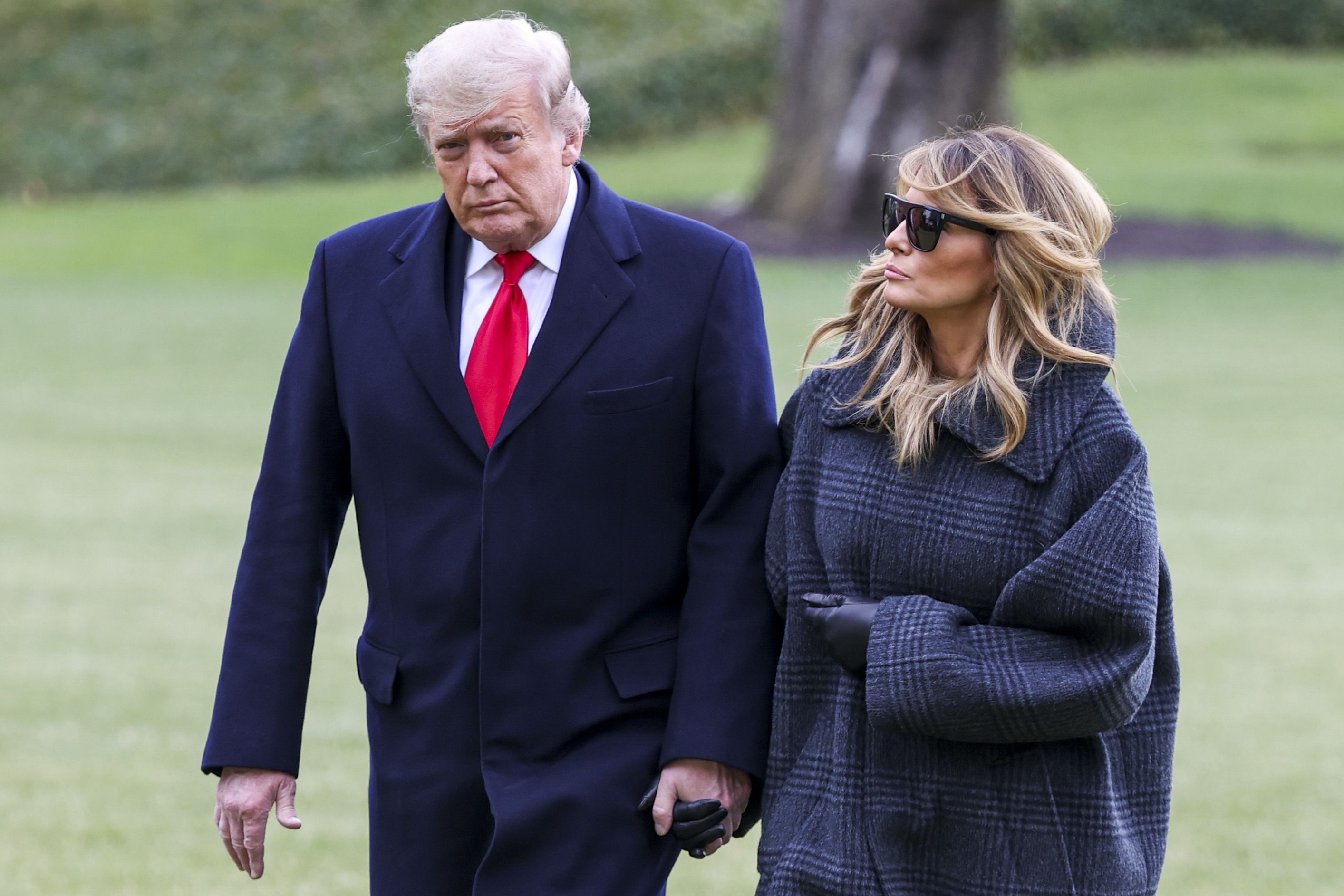
At first, it seemed like a simple pause, the kind speakers use to emphasize a point. But seconds passed. Then more. The silence stretched longer than anyone anticipated.
Trump’s expression shifted. The assertive tone that had defined his speech softened into something quieter, more inward. He looked down briefly, then out across the audience — not scanning, but searching.
The room grew still.
Then he spoke again, but this time, his voice carried a different weight.
“This is for a man,” he said slowly, “who never stopped fighting.”
There was no elaboration. No context. No name.
The audience, caught between confusion and curiosity, responded with uncertain applause. Some exchanged glances. Others leaned toward one another, whispering. But no explanation followed.
Trump resumed his speech, returning to prepared remarks as if the moment had not happened.
Yet something had shifted.
Those in attendance would later describe the pause as “unlike anything they had seen before.” It wasn’t theatrical. It wasn’t strategic. It felt… personal.
Still, without further information, the moment remained unclear — a fragment without a frame.
That clarity would come the next morning.

Just after sunrise, multiple news outlets confirmed that Barron Trump had been rushed to a private medical facility late the previous night following a sudden and serious health emergency. Details were initially limited, but sources close to the family described the situation as “urgent” and “unexpected.”
The timeline quickly drew attention.
According to reports, Trump had been informed of the situation shortly before taking the stage. Advisors had reportedly discussed whether the event should be postponed, but the decision was made to proceed — at least initially — to avoid immediate public alarm.
What had appeared, in the moment, as a brief and unexplained pause was now understood in an entirely different light.
It was not hesitation.
It was restraint.
The line — “This is for a man who never stopped fighting” — was no longer abstract. It was personal. Directed not at the audience, but at someone far more important to him.
His son.
As the news spread, reactions shifted from confusion to recognition.
Clips of the speech began circulating widely across social media, this time accompanied by the context that had been missing just hours earlier. Viewers rewatched the moment, now noticing details that had gone unseen — the slight tightening of his expression, the brief pause before speaking, the change in tone.
What had once seemed like an anomaly now felt like a glimpse behind the public image.
Throughout the day, statements from representatives confirmed that Barron Trump was receiving medical care and was under close supervision. While specifics about his condition were not fully disclosed, updates later indicated that he was stable and responding to treatment.
Trump himself did not immediately address the situation publicly.
Instead, the moment from the previous night continued to speak for him.
Political figures, commentators, and members of the public responded in varying ways, but one theme remained consistent: recognition of the human element behind the headline.
“Whatever your views are,” one attendee said in an interview, “that was a father on that stage.”
The event, originally intended as a platform for policy and messaging, had unintentionally become something else entirely — a moment of vulnerability in a setting designed for control.

In the days that followed, discussions extended beyond the immediate incident.
Observers noted how rare it is for personal crises to intersect so visibly with public responsibility. The decision to step onto that stage, to continue speaking while carrying private concern, and to reveal just a fragment of that reality — it created a moment that resonated far beyond the room.
It also highlighted the contrast between perception and reality.
Public figures are often seen as constant, unshaken, defined by their roles. But moments like this disrupt that image, revealing something more complex — the intersection of duty and personal life, of expectation and emotion.
As updates on Barron’s condition gradually became more reassuring, attention returned to the speech itself — not for its political content, but for that single, unscripted interruption.
A pause.
A sentence.
A message.
In retrospect, it was not a break in the speech.
It was the most important part of it.
Because while the audience that night may not have understood what they were witnessing, they had, in real time, seen something real — a moment where the distance between public figure and private person disappeared, if only for a few seconds.
And by the time the world understood it the next morning, that moment had already said everything it needed to say.