Donald Trump Threatens to Abandon UK Over Iran War Refusal as Diplomatic Crisis Rocks the Special Relationship
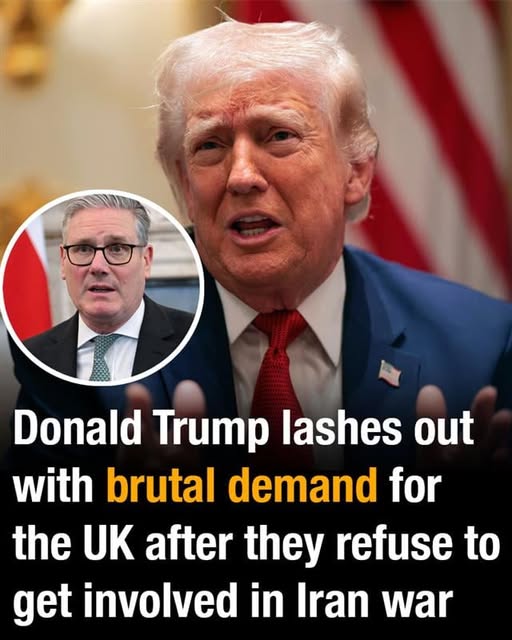
The historic bond between the United States and the United Kingdom has been thrown into sudden and dangerous uncertainty following a series of sharp statements from Donald Trump that have reverberated across the international diplomatic landscape. The situation escalated after the UK government declined to commit military forces to a developing conflict with Iran, a decision that triggered a fierce and highly unusual response from the American leader. In remarks that have fundamentally altered the tone of the transatlantic alliance, Trump warned that the United States would no longer act as a guaranteed protector if Britain refused to engage directly in Middle Eastern military operations.
The rhetoric intensified on Truth Social, where Trump criticized Britain’s reluctance and questioned its resolve on the global stage. As tensions continue to rise around the Strait of Hormuz—a crucial route for global energy transport—he delivered a blunt message directed at the UK, telling them to secure their own oil resources. He further stated that the era of automatic American support was over, declaring that the United States “wouldn’t be there to help anymore.” This stark warning arrives at a particularly fragile moment for Britain, which is already facing rising fuel costs and growing energy concerns while attempting to avoid deeper involvement in a widening regional conflict.
For many observers, this represents a major shift in the long-standing “Special Relationship” that has defined Western security cooperation for decades. By publicly challenging and potentially distancing from a key ally during a period of heightened geopolitical tension, Trump appears to be signaling a more transactional approach to foreign policy—one where support depends heavily on immediate strategic alignment. The reaction has sparked intense debate within the UK, with some political voices calling for a reassessment of its reliance on the United States, while others warn of the serious risks associated with weakening a long-standing security partnership.
At the same time, however, Trump’s stance took an unexpected turn that has left analysts divided. Alongside his criticism of the UK government, he expressed strong admiration for the British monarchy, announcing plans for a formal state visit for King Charles III and Queen Camilla. In a striking contrast in tone, he referred to the upcoming royal visit as a “momentous occasion” and spoke warmly about hosting a “beautiful banquet dinner” at the White House. His praise for the King stood in sharp contrast to his condemnation of Britain’s elected leadership, creating a confusing dual message within the same diplomatic narrative.
This contrasting approach has fueled debate over whether the United States is attempting to separate its relationship with the British government from its relationship with the monarchy, or whether this is a deliberate form of political pressure. Critics argue that such inconsistency risks undermining trust and destabilizing a long-standing alliance, while supporters view it as a strategic reminder that international partnerships are not unconditional.
As the planned state visit draws closer, uncertainty continues to grow. The coexistence of ceremonial diplomacy and harsh political rhetoric has created an unusual diplomatic tension that complicates the future of the alliance. Whether the UK can maintain its strategic independence while preserving close ties with the United States remains an open question. For now, what was once considered one of the world’s most stable partnerships appears to have entered a far more unpredictable and negotiated phase.