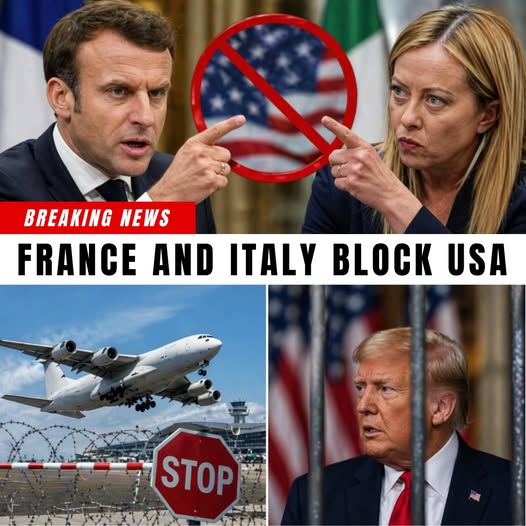
A Sudden Break That Signals Deeper Strains in NATO Unity
🚨 Historic NATO Power Shift Begins
Canada challenges long-standing U.S. influence as 39 nations prepare for a decisive and unprecedented vote that could reshape global alliances.
In an extraordinary turn of events that has stunned policymakers and observers across both sides of the Atlantic, key European powers — notably France, Italy, and Spain — have taken coordinated steps to block United States military operations tied to a potential conflict with Iran.
Over the span of just 72 hours, actions once considered unthinkable within the framework of the NATO alliance have materialized, raising urgent questions about the cohesion and future of the transatlantic partnership.
The decisions, described by European officials as grounded in legal and strategic concerns, effectively halted the use of critical airspace and military infrastructure essential for U.S. logistical operations.
France reportedly denied the transit of weapons shipments, while Italy restricted access to key installations in Sicily — long regarded as a cornerstone of Mediterranean military coordination. Spain, in a move that signaled full political commitment, closed its airspace entirely to U.S. military aircraft associated with the operation.
Political Fallout and Escalating Rhetoric
The response from Donald Trump was swift and characteristically blunt. Labeling the European actions as a display of weakness, he publicly criticized the governments involved, accusing them of undermining allied strength at a critical geopolitical moment.
Yet across Europe, the narrative has been markedly different. Leaders and analysts have framed the moves not as abandonment, but as a principled stand against what they describe as a “reckless and potentially unlawful escalation.”
This divergence in framing underscores a broader shift in how European nations are positioning themselves on the global stage.
While transatlantic unity has long been a cornerstone of Western security architecture, recent years have revealed growing discomfort within Europe regarding unilateral military decisions originating in Washington. The current standoff appears to crystallize those tensions into tangible policy actions.
Operational Impact and Strategic Consequences
From a military standpoint, the implications are immediate and significant. The denial of airspace and base access disrupts established logistical corridors that have underpinned U.S. operations in the Middle East for decades.
Without these routes, the efficiency, speed, and scale of any sustained military campaign could be severely constrained.
Moreover, the symbolic weight of these decisions may prove even more consequential than their operational impact. For decades, NATO has functioned not only as a military alliance but as a political signal of Western unity.
The coordinated refusal by three major European members to support a U.S.-led operation challenges that perception, suggesting that alliance commitments may be more conditional than previously assumed.
A Historic Inflection Point in Global Power Dynamics
What makes this moment particularly striking is the speed and coordination with which these decisions unfolded. Diplomatic disagreements between the United States and European allies are not new, but rarely have they translated so quickly into concrete restrictions on military cooperation. Analysts are already describing the episode as a potential inflection point — one that could redefine the balance of influence within NATO and reshape the broader geopolitical landscape.