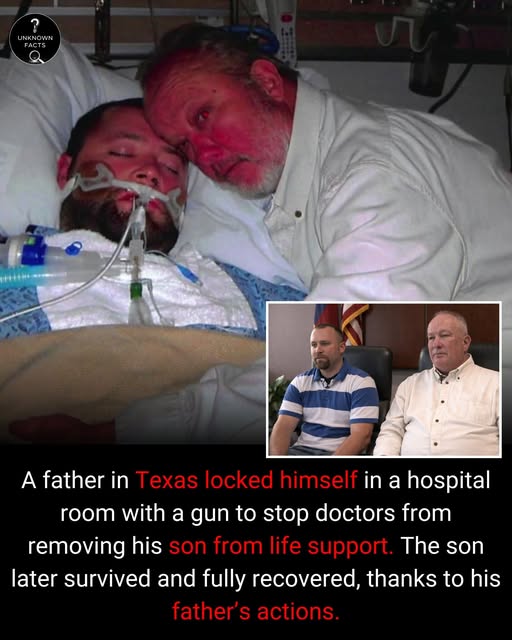
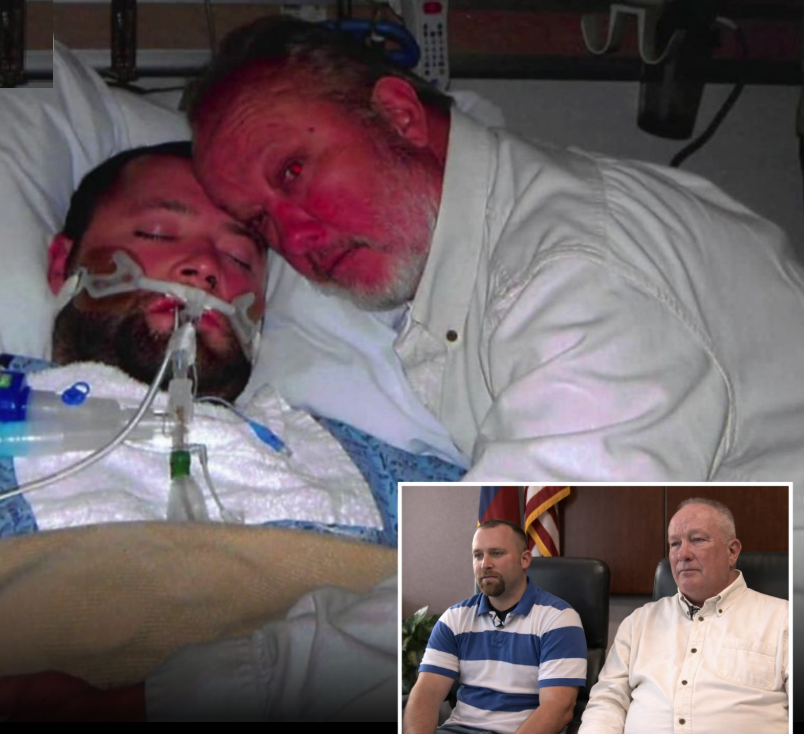
The moment was already spiraling beyond comprehension. In a hospital meant for healing, a father raised a gun—not in rage, but in refusal. He aimed it at the very people trained to save lives, while a SWAT team assembled outside the room, rifles trained on a man standing over his unconscious teenage son. Doctors had finished their assessments. Paperwork was prepared. Organ procurement teams were alerted. In the cold, procedural language of medicine, the boy was already being treated as gone. The room had gone quiet in that way hospitals do when decisions are considered final. Yet in that stillness, something impossible happened—something so small it could have been dismissed, but so real it changed everything.
George Pickering II had been told, repeatedly and with professional certainty, that his son would never recover. Brain injury, no meaningful response, no hope. The medical system moved forward as it was designed to do, transitioning from treatment to preparation. But George couldn’t reconcile what he was hearing with what he felt. Somewhere beneath the fear, exhaustion, and pressure, he believed his son was still there. Not logically. Not medically. But instinctively. And that belief hardened into resolve when he felt the process moving faster than his heart could accept.
He didn’t see himself as a threat. He saw himself as a wall.
Surrounded by doctors, administrators, and legal protocols, George became the last obstacle between his son and a conclusion he refused to accept. His actions crossed a legal line, there’s no denying that. But they were fueled by one singular demand: time. He wasn’t asking for miracles, only for the chance that certainty might be wrong. As armed officers aimed at him and negotiators pleaded for him to stand down, George held his ground, insisting that his son deserved more than a decision made while he was still warm, still breathing, still his child.
Inside that room, the hours stretched. Tension pressed against every breath. And then it happened.
A faint movement. A slight pressure. His son’s hand squeezed his.
That single motion unraveled everything the charts had declared. It wasn’t dramatic. It wasn’t loud. But it was undeniable. The boy wasn’t gone. He was still there, fighting his way back through whatever darkness had trapped him. The certainty that had justified the paperwork collapsed under the weight of that living proof.
The standoff ended. The gun was lowered. George was arrested.
But his son began to recover.
Slowly, painfully, against every expectation, the young man regained consciousness. The future that had been written off reopened, fragile but real. While George faced prison time for his actions, his son left the hospital alive—something that would not have happened if the process had continued uninterrupted.
The outcome is complicated. A father broke the law. A hospital followed protocol. A system designed for efficiency collided with a human instinct that refused to yield. There are no easy conclusions, no clean heroes or villains. Only a stark reality: one man’s illegal stand delayed an irreversible decision long enough for life to reassert itself.
Today, both father and son live with that knowledge.
George paid a price for his actions. His son carries the weight of knowing how close he came to being declared gone before he truly was. Their story exists in that uncomfortable space where love, fear, medicine, and law collide—forcing us to ask difficult questions about certainty, timing, and who gets the final word when a life hangs in the balance.
What was meant to be a tragedy became something else entirely. Not because of a grand miracle, but because of one stubborn belief, one demanded pause, and one small movement that proved the ending wasn’t written yet.