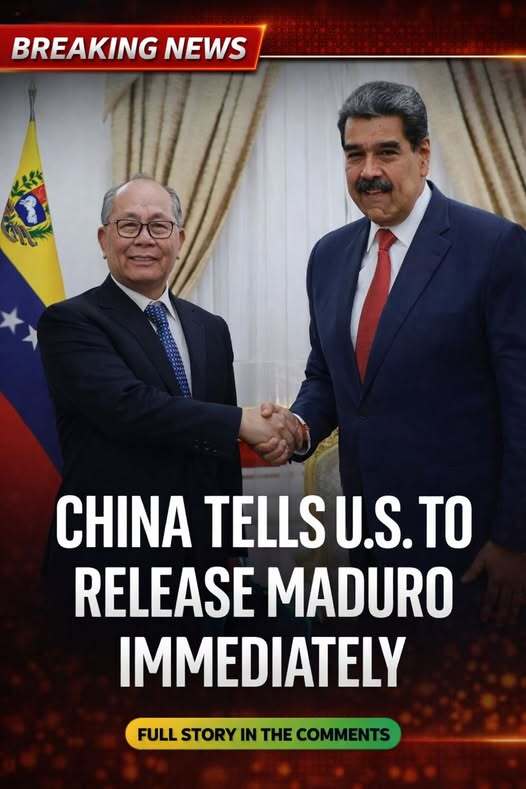

The warning came like a slap across the face of Washington’s carefully managed narratives. China had openly demanded that the United States release Venezuela’s Nicolás Maduro, just hours before his scheduled court appearance in New York, a move that seemed less like conventional diplomacy and more like a calculated provocation. Simultaneously, Donald Trump, never one to hold back his words, took aim at Colombia, publicly calling its president a “sick man” and hinting that his tenure might soon be over. In a matter of hours, the delicate balance of international power—already strained—seemed to teeter on the edge of chaos. Alliances, long assumed to be stable, were suddenly showing cracks, and the warning was clear: one misstep, one poorly timed declaration, and entire regions could be thrown into instability.
For American policymakers, the day was nothing short of a geopolitical stress test. China’s blunt call for Maduro’s release was more than performative grandstanding; it was a deliberate assertion of influence, a signal that Beijing is willing to challenge U.S. authority far beyond its immediate regional interests in the South China Sea or in trade negotiations. By tying Chinese prestige to the fate of a leader widely condemned in the West, Beijing made a statement about its readiness to play in spaces traditionally dominated by the United States. Venezuela, long considered a U.S. sphere of influence, suddenly became a litmus test for American credibility. Every move, every response—or lack thereof—would be scrutinized not only in Caracas and Washington but also in capitals across Latin America and beyond.
The stakes were heightened by the timing. Maduro’s New York court appearance, expected to draw significant international attention, became a stage on which power dynamics were laid bare. It was a symbolic theater, where diplomacy collided with spectacle. The message from Beijing was unmistakable: China is not just an economic rival; it is a strategic actor willing to intervene where it sees the United States asserting itself. Implicit in the demand was a challenge to American moral authority: could the U.S. enforce justice in Latin America without encountering resistance from other global powers, or was its influence more fragile than previously imagined?
As if the situation weren’t already volatile, Donald Trump’s intervention added another layer of tension. By publicly deriding Colombia’s president as a “sick man” and suggesting that his hold on power was tenuous, Trump transformed a standard political observation into a provocative signal of instability. Latin American governments, already wary of U.S. interference, were reminded that American rhetoric can act as a destabilizing force in its own right. For ordinary citizens in Colombia, the words sounded like a thinly veiled threat; for diplomats in Bogotá and Washington, they raised urgent questions about the intersection of personal politics, U.S. foreign policy, and regional stability.
Taken together, the twin shocks—China’s challenge and Trump’s provocative rhetoric—exposed deep vulnerabilities in how the United States manages its influence across the Americas. On one hand, Beijing’s move demonstrated that Washington can no longer assume uncontested authority over decisions affecting leaders like Maduro. On the other, Trump’s words revealed how domestic political theatrics can reverberate internationally, inadvertently complicating longstanding diplomatic relationships. The combination underscored a simple truth: in today’s multipolar world, the U.S. is no longer the unchallenged arbiter of outcomes in its backyard. Every public statement, every legal action, every procedural step is subject to scrutiny—and potential disruption—by actors who understand the power of optics, timing, and symbolism.
Moreover, the events illuminated broader patterns in global diplomacy. China’s assertiveness in defending Maduro is not an isolated gesture; it is part of a broader strategy to assert influence in Latin America, build alliances with countries that have contentious relationships with Washington, and project power in ways that complicate U.S. policy. By tying its position to a figure like Maduro, Beijing not only challenges American authority but also positions itself as a defender of sovereign decision-making, appealing to countries in the region that resent external pressure. In parallel, Trump’s verbal attack on Colombia signals that personal and political motives in Washington can have immediate, destabilizing effects across the hemisphere. When the president—or former president—frames foreign leaders in personal, often disparaging terms, it changes the calculus for both allies and adversaries, forcing them to respond to rhetoric as much as policy.
In short, within a single, tumultuous day, Washington faced a rare confluence of crises: one legal, one diplomatic, both emblematic of a shifting world order. China tested the limits of U.S. influence with an unambiguous demand, while Trump reminded the hemisphere that American words—whether uttered by a sitting official or a former one—carry outsized weight. Alliances that were once assumed stable suddenly required reaffirmation, strategies once taken for granted needed recalibration, and the fragile equilibrium that governs Latin American geopolitics was rendered visibly precarious. One misjudgment could trigger consequences far beyond courtrooms and press briefings, potentially reshaping relations across the continent.
As the dust settled, the implications remained clear. The United States can no longer operate under the assumption that it controls the narrative or the outcomes in Latin America. China has demonstrated a willingness to assert itself publicly and provocatively, testing the boundaries of traditional power structures. At the same time, American domestic political dynamics—embodied in Trump’s incendiary statements—exert real pressure on regional stability, highlighting how intertwined internal politics and foreign diplomacy have become. Washington now faces a complex calculus: respond firmly to Beijing without escalating tensions, manage the fallout from Trump’s rhetoric, and reassure allies in a region long accustomed to external meddling. In other words, one misstep, one poorly measured word, could ripple across borders, emboldening adversaries and unsettling allies alike.
In the end, the events of that day were more than a single headline or viral news story. They were a stark illustration of the delicate and contested nature of global power in the 21st century. China’s public demand and Trump’s provocations exposed the limits of traditional influence, underscored the risks of domestic political interference, and reminded policymakers that in a multipolar, hyper-connected world, every action and word carries weight. For Washington, it was a warning: the era of uncontested authority is over, and navigating this new reality requires a blend of strategic patience, diplomatic savvy, and an acute awareness of how global audiences interpret both legal actions and political statements. The consequences of miscalculation are no longer theoretical—they are immediate, visible, and potentially far-reaching.