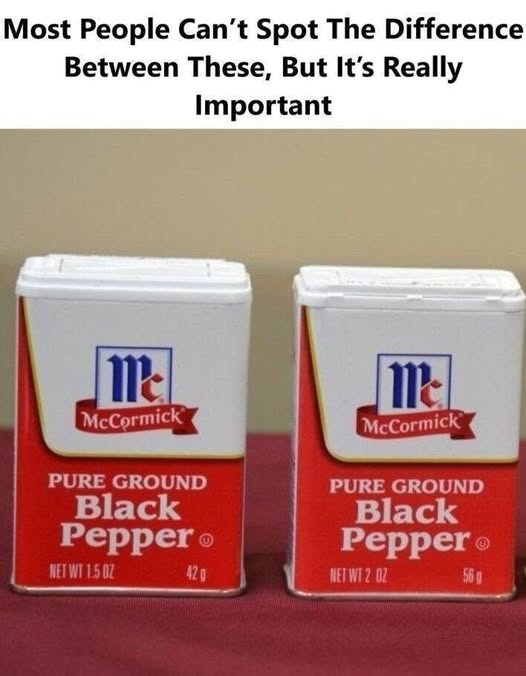
In the split second between reaching for a product and placing it in a shopping cart, something subtle but powerful is at stake: trust. Consumers rarely pause to read every word on a label, rarely weigh every ounce on a scale; they rely on a combination of habit, instinct, and the cues that the product presents visually. On a crowded spice shelf, rows of jars and boxes compete for attention. Among them, a familiar red box stands proudly, unchanged in appearance. Its colors are bright, its logo recognizable, its packaging solid and full-looking. There is comfort in that visual continuity. For decades, shoppers have relied on that same box to promise quality, flavor, and value. It carries more than just paprika or cinnamon; it carries a tacit agreement: that what is on the label matches what is inside.
But sometimes, the promise is more fragile than it appears. Inside that same box, a careful consumer might discover something has quietly disappeared—not the flavor, but the weight, the quantity. Ounces have been shaved off, a layer of trust eroded, a subtle shift that goes unnoticed at first glance but is meaningful over time. When a clear, honest rival stands beside it, a competitor whose containers transparently display their contents, the contrast becomes impossible to ignore. Every grain is visible, every measure certain. The consumer’s eye immediately catches the difference. And in that instant, a question forms in the mind of the shopper: is this product offering the same honesty that its appearance suggests, or is it merely illusion?
This dilemma is more than a question of seasoning; it reflects a tension that stretches across modern commerce. What unfolded between McCormick and Watkins—a legal dispute over packaging and perceived misrepresentation—is a perfect microcosm of the broader conflict between what is technically legal and what feels fair. McCormick, the company whose familiar red boxes dominate the spice aisle, maintains that it followed all regulations. Every label correctly lists the weight, every statement meets the standard set by regulatory authorities. There is no intent to deceive; in the eyes of the law, McCormick is compliant. Yet Watkins, whose clear jars allow shoppers to see exactly what they are getting, highlights an uncomfortable reality. When consumers can directly compare the products, the discrepancy becomes obvious. The opaque packaging of McCormick’s boxes makes them appear more generous than they truly are. Legally, disclosures may be printed in fine print or footnotes, but human perception works differently. The eye, drawn to fullness and color, registers one thing; the fine print, even if technically accurate, is easily overlooked.
It is in this subtle misalignment that the ethical debate arises. Consumers rarely question the rules—they operate on trust, guided by prior experience, visual cues, and brand familiarity. When the packaging signals more than the contents deliver, that trust erodes. And once lost, it is difficult to recover. The McCormick-Watkins case forces companies and consumers alike to confront an uncomfortable truth: legality does not always equate to fairness. It asks whether adherence to regulations is sufficient when perception shapes behavior and loyalty.
The implications of this dispute extend well beyond the spice aisle. In an age where attention spans are short, shopping carts move quickly, and brand recognition is cultivated through repetition and color psychology, packaging is no longer neutral. Every choice—from the size of the container to the brightness of a label—communicates value. When these choices obscure reality, even subtly, the line between clever marketing and manipulation blurs. It is not merely a question of ounces or grams; it is a question of the social contract between a company and its customers. Trust, once taken for granted, is revealed to be a fragile commodity.
Consider the everyday consumer, unaware of the exact legal weight, yet sensitive to perception. They might reach for McCormick’s box out of habit, reassured by its familiar design and the mental shorthand of brand loyalty. Then, they notice Watkins’ clear jars. They can see every particle, every empty space, every ounce of spice exactly as it exists. The comparison is jarring. Even if McCormick’s labeling is accurate, the transparency of Watkins communicates honesty and value more immediately. What feels fair clashes with what is legal, and in that tension, the consumer is left to navigate a landscape where appearances often dominate reality.
Over time, these seemingly small decisions accumulate. Shoppers who feel misled may start to question other products from the same brand. Loyalty erodes incrementally, not because the product failed, but because trust was quietly siphoned away. Every reduction, every opaque package, every subtle “shrinkflation” carries a cost invisible to accountants but real to the human perception of fairness. No label can completely offset the slow, almost imperceptible draining of faith that comes from repeated minor betrayals of expectation.
Ultimately, the McCormick-Watkins story is a cautionary tale. It is about the power of transparency, the importance of perception, and the responsibility companies carry when their products are placed in the hands of millions. In a world where shopping is increasingly visual, where split-second decisions define behavior, packaging is a moral as well as a commercial choice. When consumers reach for that familiar red box, they are not just buying paprika—they are buying reassurance, consistency, and trust. And when that trust is tested, even subtly, the consequences ripple far beyond the spice shelf, shaping the relationship between companies and the people who depend on them.