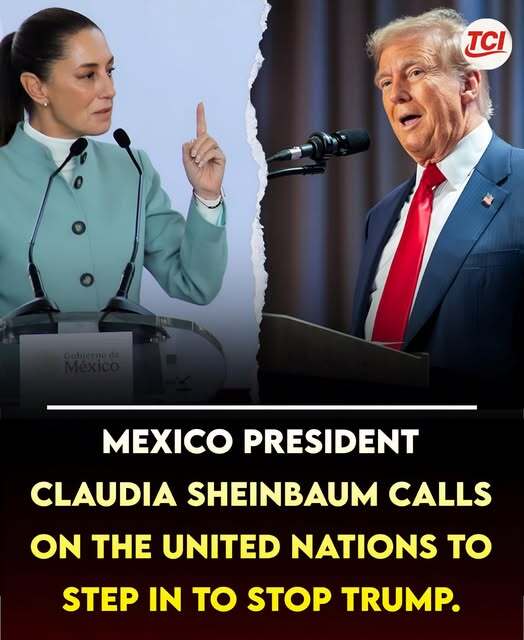
Mexico’s warning landed like a thunderclap—echoing far beyond Mexico City and into the capitals of South America. In an unusually sharp and public rebuke, President Claudia Sheinbaum openly accused the United States of violating international law after a surprise military operation in Venezuela led to the capture of President Nicolás Maduro. She framed the action not as a narrow tactical dispute, but as a dangerous breach of sovereignty with implications for the entire region, invoking foundational legal principles such as Article 2(4) of the UN Charter and Mexico’s own long‑standing non‑intervention policy.
Sheinbaum’s choice of language was deliberate. By calling attention to the UN Charter—which forbids the threat or use of force against the territorial integrity or political independence of states—she elevated the matter from a quarrel over one country to a potential test of the legal order that underpins global diplomacy. Her government explicitly labeled the U.S. operation as a violation of international law, emphasizing the need to respect sovereignty and peaceful dispute resolution. The statement reminded Mexico’s neighbors that arbitrary military incursions risk destabilizing not only Venezuela, but the fabric of relations across Latin America and the Caribbean, a region Mexico insists should remain a “zone of peace”.
That frming resonated quickly in capitals from Buenos Aires to Santiago, where memories of past coups, covert operations, or foreign intervention remain vivid. In many Latin American countries, the specter of outside powers imposing political change—as happened throughout the 20th century—still shapes national identity and diplomatic priorities. Sheinbaum’s words thus tapped into a deep historical current: the belief that external military force has often brought instability rather than democracy or well‑being.
Her appeal to the United Nations and international law placed multilateralism at the center of the crisis. Rather than framing the situation solely as a bilateral dispute between Mexico and the United States, Sheinbaum insisted that global institutions must play a central role in resolving disputes involving sovereign nations. Mexico’s criticism was not limited to nuance; it included a call for dialogue, negotiation, and mediation, underscoring that peaceful processes—rather than force—should shape the future of Venezuela.
Crucially, Sheinbaum’s statement did more than condemn Washington; it drew a symbolic red line around Mexico’s identity in world affairs. By grounding her criticism in both constitutional principles and international law, she signaled that Mexico’s foreign policy remains rooted in long‑established norms of non‑intervention and respect for sovereignty. That insistence sends a message to Washington that cooperation on issues such as migration, security, and trade cannot come at the cost of Mexico’s core diplomatic principles.
Sheinbaum’s remarks also responded to the broader regional fear of coercive power dynamics. The U.S. operation—confirmed by multiple sources to have involved strikes and a raid that captured Maduro and transported him to the United States to face federal charges—sparked global debate about legality and precedent. Critics argue it could undermine the norm that leaders of independent states cannot be seized without consent or a clear legal basis under international frameworks. Supporters in the U.S. framed the mission as a law‑enforcement action targeting an accused criminal, but the global backlash has been significant.
Within Mexico, anxiety about sovereignty and regional precedent intersects with domestic politics and security cooperation with the United States. Trump’s administration has publicly hinted at more assertive actions against drug cartels and even referred to the possibility of operations beyond Venezuela, including in Mexico and other countries. Although Sheinbaum has downplayed the likelihood of direct U.S. strikes on Mexican territory—citing cooperation rather than confrontation—her rhetoric reflects deep concern about the implications of unfettered military action in the hemisphere.
Sheinbaum’s stance also underscores that solidarity in Latin America is under strain. Some states have condemned the U.S. intervention, while others have offered more muted responses or even tacit support for actions targeting widely accused authoritarian leaders. Mexico’s strong language positions it as a defender of legal norms rather than an enabler of geopolitical power plays, even when the operation in question was directed at a controversial figure like Maduro.
Her approach has multilayered significance. On one level, it is a defense of sovereignty and legal order. On another, it is a strategic message to Washington that Mexico will not abandon its principles even while maintaining cooperation on issues like drug trafficking and migration. By anchoring her critique in international law rather than merely political rhetoric, she challenges the idea that major powers can act unilaterally without consequences for diplomatic trust and regional stability.
As the hemisphere absorbs the fallout from the Venezuelan operation, one central question remains: will diplomacy hold, or will unilateral use of force reshape the norms that govern power in the Americas? Mexico’s response under Sheinbaum underscores a belief that the answer must lie in law, dialogue, and mutual respect—not in coercion. The coming weeks and months will test whether regional leaders can uphold these principles in the face of pressure and shifting power dynamics, or whether fears of foreign intervention will deepen divisions across the hemisphere.